Author: Rudramani Pandey

  • Architecture of a Quantum Computer

    Preface – This post is part of the Quantum Computing series.

    Introduction

    In the previous module, we discussed some of the most important concepts in Quantum Mechanics and how they are being utilized to design a functional Quantum Computer. In this module, we will discuss the basic architecture of a Quantum Computer.

    The architecture of a Quantum Computer

    Image Source: Fu, Xiang et al. “A heterogeneous quantum computer architecture.” Proceedings of the ACM International Conference on Computing Frontiers (2016): n. pag.

    Layers of Quantum Computer

    As shown in the figure above, there are total of seven layers that can be divided into five main categories as follows:

    1. Qubits

    The two bottom-most layers implement the main hardware of the Quantum Computer. The bottom-most layer is the Quantum Chip which contains the actual arrangement of qubits. Right above the quantum chip, there exists a Quantum-Classical Interface. The primary function of the Quantum Classical Interface is to make the measurement. Classical bits are required to make measurements on a qubit.

    2. Compilers

    A compiler is mainly a translator. It translates a high-level language program into the corresponding machine code. Quantum Computers also need Compilers to translate high-level instructions into corresponding low-level instructions that can be executed on the hardware level.

    The Compiler block shown in the figure consists of two main parts: a Conventional Host Compiler and a Quantum Accelerator Compiler.

    The Conventional Host Compiler compiles the classical logic and the Quantum Accelerator Compiler produces the quantum circuits. The quantum compiler will perform quantum gate decomposition, reversible circuit design, and circuit mapping and translates the logical quantum operations into a series of physical operations.

    The third dimension in the figure represents the error correction schemes that drive the logical to the physical transformation of the quantum instructions.

    3. Quantum Instruction Set Architecture (QIST)

    QIST is the main divide between Quantum Hardware and Software. The Quantum Instruction set provides the programmer with the basic logical instruction set to facilitate the designing of quantum algorithms. The Instruction set also allows the programmer to go with various encoding schemes and provides error correction functionality.

    The block right below QIST is divided into two parts:

    1. QEC

    QEC refers to Quantum Error Correction. Quantum Computers are error-prone, so some error correction schemes must be implemented to make sure the programs on the computers give accurate results. The First Error Correction Codes for Quantum Computers was given by Peter Shor called Shor codes. Since then, various error-correcting codes have been developed making QED an active area of research in the Quantum Computing Community.

    2. QEX

    QEX refers to Quantum Execution. QEX executes the instructions generated by the Compiler.

    4. Software

    The Programming Paradigm and languages block represent the high-level interface used by the programmer or algorithm designer to program a Quantum Computer. Some famous programming frameworks to program Quantum Computers are Qiskit, Cirq, Q#, and many more.

    5. Quantum Algorithm

    Quantum Algorithm is the topmost layer in the Quantum Architecture Stack. Quantum Algorithms are designed by exploiting the Quantum-Mechanical properties of the hardware layers. The high-level programming languages and compilers must be developed such that the algorithms can easily exploit the underlying quantum hardware.

    Information Source: Fu, Xiang et al. “A heterogeneous quantum computer architecture.” Proceedings of the ACM International Conference on Computing Frontiers (2016): n. pag.


  • Important Definitions related to Quantum Computing

    Preface – This post is part of the Quantum Computing series.

    Introduction

    To recap, in the last module, we explored the inner workings of a Quantum Computer by mathematically defining the notion of a Quantum State. We introduced the mathematical notation used to define quantum states and, in the end, discussed the design and operating principles of a D-Wave Quantum Computer.

    In this module, we will provide rigorous definitions and corresponding intuition of some technical terms we have encountered in the previous modules.

    Qubit

    Qubit is short for Quantum bit. A qubit is a fundamental unit of Quantum Computation. The book Quantum Computation and Quantum Information by Neilson and Chung -which is as close to a standardized textbook on Quantum Computing as we’ve got so far- defines a qubit as an abstract, mathematical object. Although – as some of you may recall from previous modules – a qubit is a physical entity, defining it as an abstract, mathematical object will yield to us the benefit of describing it as a generalized object, independent of its specific, physical method of implementation.

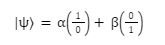
    A qubit is the fundamental unit of quantum information. A qubit, just like a classical bit has a state. The state of a qubit is described using Dirac’s notation (“”) which is the standardized notation used to describe quantum states. A qubit can be in states |0, |1⟩, or a linear combination of states |0 and |1and as shown below:

    =α|0+β|1

    Here,α and β are complex numbers describing probability amplitudes of the qubit being in the |0 or |1 respectively. |0 and |1 are the orthonormal basis vectors in a two-dimensional vector space. Thus, a qubit can be described as a unit vector in a two-dimensional vector space.

    Using vector notation, the above equation can be written as:

    vector notation

    Superposition

    Superposition is one of the fundamental principles of Quantum Mechanics. The wave-particle duality describes that an electron behaves as both a wave and a particle, but what does it actually mean? How can something behave as both a wave and a particle? Classically, we know that an object can either be discrete or continuous. But how can it be both? Let’s find out!

    The Double Slit Experiment

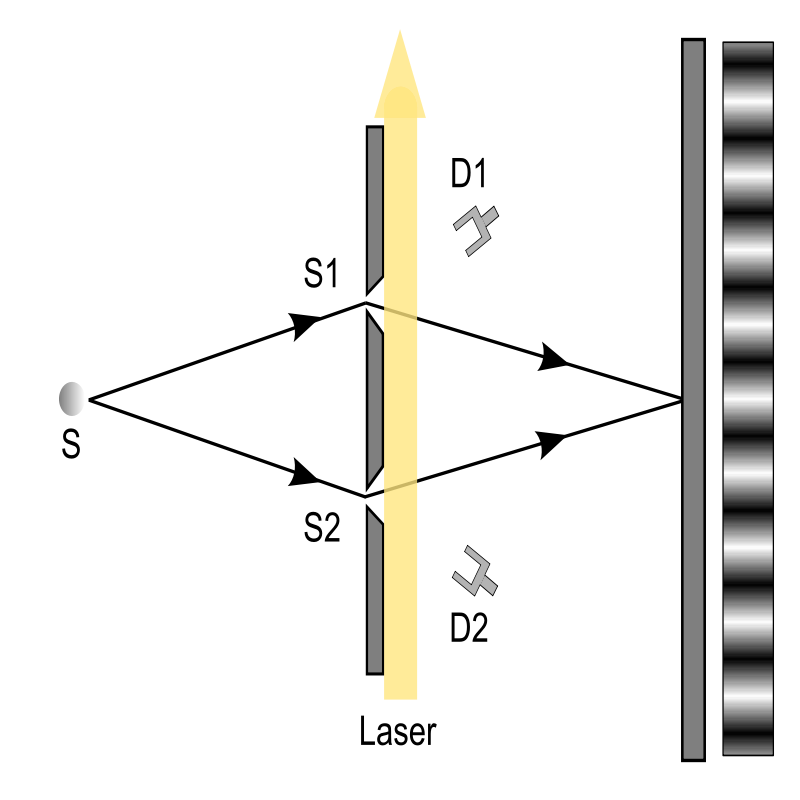
    Thomas Young in 1802 designed an experiment to demonstrate the wave nature of light. The Double Slit experiment was designed such that a light source randomly launches photons at a barrier containing two slits as shown in figure.

    ————– Double_Slit_Experiment_with_detectors

    Image Source: 老陳, CC BY-SA 4.0, via Wikimedia Commons

    The screen behind the barrier should record the pattern which if the photons are assumed to be particles should show something like two vertical lines of light passing through the barrier.

    Instead, the screen records an interference pattern as shown below.

    Double_slit_interference

    Interference patterns are generally generated when waves constructively and destructively interfere with each other. So, although Mr. Young succeeded in demonstrating the wave nature of light no one really understood what was really going on until the theory of Quantum Mechanics was formalized.

    So, what on Earth is really going on? Well, the thing is no one really understands what is going on. The path of the photons, the slit they go through and the path they take is not exactly traceable. As we know, measuring a quantum system collapses the superposition, so we cannot detect exactly how photons bring about an interference pattern. But we do know that there must be something fundamentally wave-like in the nature of photons to bring about the interference pattern.

    Superposition

    Later, it was discovered that after going into the slit, the photon exists in superposition. Think of it like a dense cloud, the photon can exist anywhere within the cloud with each position corresponding to a probability amplitude. This is Superposition.

    Superposition is defined as the ability of a quantum system to be in a combination of multiple states at the same instance.

    Measurement

    Measurement collapses the superposition. When a quantum system is measured, the superposition collapses and the system comes down to one of its basis states.

    Two-level superposition

    Two level superposition

    Four level superposition

    Four level superposition

    Entanglement

    Entanglement is the phenomenon associated with quantum systems where two systems are correlated to each other such that the measurement or manipulation of one system will affect the other immediately even when separated by vast distances.

    To understand Entanglement better, let’s take an example. Let’s assume we have two balls that are entangled to each other. The balls are in a superposition of black and white before observation, once observed a ball can either be black or white. Let’s say we have two observers Alice and Bob each observing one ball. The balls are entangled so when Alice observes her ball and sees a black ball Bob will immediately see his ball turn white or vice a versa. (Alice and bob can both see the ball turn the same color as well, it depends upon how the objects are entangled).

    Albert Einstein never could reconcile with the theory of entanglement. He referred to entanglement as “spooky”. And it was a perfectly valid reaction as scientists did not know how exactly entanglement worked at the time. How can an object pass information to another object separated by a distance as large as two different galaxies almost immediately? This is only possible if the objects are communicating faster than the speed of light which completely breaks Einstein’s theory of special relativity. This is a common misconception that was later proved false after conducting various experiments. Even Quantum Physics cannot achieve faster than light communication.

    Teleportation

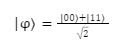
    Quantum Teleportation is the process of sending quantum information from a sender to a receiver. Teleportation is achieved through entanglement, the sender and receiver’s qubits are entangled in Bell States. The Bell State is described as follows in a two-qubit system:

    Bell State

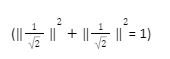
    Here, in |00 and |11the first 0/1 represents the first qubit and the second 0/1 represents the second qubit. Both the states are in equal superposition with probability amplitude probability amplitude:


    states are in equal superposition

    Teleportation sends classical information across the channel so it cannot achieve faster than light speed as we discussed in the previous section.

  • What is a Quantum Computer?

    Preface – This post is part of the Quantum Computing series.

    Introduction

    So far, we have discussed how Quantum Computing in contrast to Classical Computing. In this module and upcoming modules, we will start to discuss the inner workings of a Quantum Computer. In this module, we will discuss Quantum Processors Units or QPUs and their architectures. In the end, we will demonstrate the inner workings of the D-Wave Quantum Computer. We have much to discuss so, let’s skedaddle!

    What is a Quantum Processing Unit?

    A Qubit is the fundamental part of a QPU. All the operations in a QPU are performed on Qubits. Now, we would like to point out at the very beginning that many architectures exist to arrange Qubits on Quantum Processors and all of them have their advantages and drawbacks. As of now, no architecture is proven to be better in terms of efficiency for all kinds of problems. Some promising contending architectures include Superconducting, Photonic, and Trapped ion. Now, we realize these names may sound daunting but just keep a lookout for these in the literature until we eventually discuss each architecture in more detail.

    What is a Quantum Computer?

    In the previous sections and modules, we talked about Quantum Computers very abstractly. There were no rigorous proofs or mathematical formulas to actually give you a technical context into the inner workings of Quantum Computers. Here, we will not go all maniac on you with mathematical formulas but we will give you enough to demonstrate our point more clearly. Don’t worry if you don’t understand all of it at once. We advise you to go through this section and do some additional readings we provide at the end of this module.

    We will start by defining and representing a Quantum State mathematically. A Quantum State is represented using a vector. The vector represents the probability of the qubit being in that state. A two-qubit system can be represented as shown below.

    |0=1 0         |1=0 1

    The Quantum States are described using the bra-ket notation. We will discuss it in detail, for now “| ” also known as “ket” is used to specify that 0 and 1 are quantum states.

    The vectors representing the quantum states describe the probability of the qubit being in that state. This is a very powerful idea and should be digested as we go further into Quantum Mechanics. Here, the first vector (1 0) describes that the qubit is in the |0 state with probability 1 and |1 state with probability 0. We index the vector starting with 0 and go further along up to the total number of qubits in the system.

    Similarly, the second vector (0 1) describes that the qubit is in the |0state with probability 0 and |1state with probability 1.

    Representation of a Quantum State

    A pure Quantum state is a superposition of classical states written as,

    Representation of a Quantum State

    Where, is a complex number representing the probability amplitude of each state in |.

    Mathematically, the states |0, . . . , |N-1 form an orthonormal basis of an N-dimensional Hilbert space.

    A quantum state | is a vector in this space, usually written as an N-dimensional column vector of its amplitudes:

    quantum state in N dimension

    Example of a Quantum Computer: D-Wave

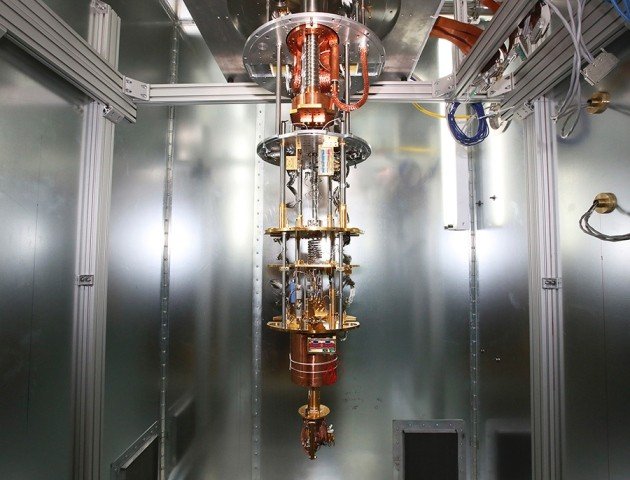
    The picture above shows a D-Wave Quantum Computer. Most of the apparatus you see is used to keep the Quantum Processor situated at the bottom at sub-zero temperature. The Qubits get noisy if the temperature is not maintained which results in Quantum Decoherence. Quantum Decoherence results in errors, noise, and sometimes even loss of information in qubits.

    The D-Wave Quantum System is implemented superconducting qubits. There are two models based on which Quantum Computers can be built:

    • Quantum Gate Model: In this model, problems are expressed in terms of quantum gates. Companies like Microsoft, IBM, Google, etc. use the Gate Model in their Quantum Computers.
    • Quantum Annealing Model: In this model, problems are expressed in terms of optimization problems from which the computer then finds the optimal solution. D-Wave systems use Quantum Annealing to search for solutions in state space.

    D-Wave has commercialized its quantum services through its cloud platform Leap. With their latest QPU (Quantum Processing Unit) containing over 5000 qubits, D-Wave is indeed a major player in the Quantum arena.

    With this, we conclude this module. In the next module, we will discuss important Quantum Phenomena like Superposition, Entanglement, Interference, and teleportation in detail.


  • Difference between Classical Computing and Quantum Computing

    Preface – This post is part of the Quantum Computing series.

    Introduction

    In the previous module, we discussed classical computing in detail. In this module, we will discuss the key differences between classical and quantum computing. This is perhaps the last module before we dive deep into the nitty-gritty details of quantum computing. So, without further ado let’s get started, shall we?

    Classical Computing

    Once again, Classical or Modern Computers are made up of fundamental units called “bits”. A single bit can take a binary state i.e., 0 or 1, high or low. A bit can be in a single state at a time. It can either be 0 or 1, either at high or low voltage, and nothing in between.

    Quantum Computing

    Quantum computers on the other hand, as we discussed before are fundamentally different from Classical Computers. Fundamental units of Quantum Computers are called Quantum bits or “Qubits”. Unlike “bits”, “qubits” can be in multiple states at the same time. But before talking about the nature of qubits, let’s talk about what exactly they are made of.

    Transistors that make up classical processors are basically silicone (NPN/PNP) semiconductors. The transistor is designed to represent the high or low voltage; the principle as we discussed above, on which modern computing is tethered. An interesting challenge presented itself when physicists began thinking about what should be used to represent a Qubit.

    It was quite obvious that it should be a Quantum material, but basically, everything is a Quantum Material when it is cooled below a certain threshold temperature. Photons, electrons, superconducting materials, etc behave Quantum Mechanically. So, where to start?

    Well, the good news is there are several different effective Quantum Computers that use different materials as qubits. Their effectiveness and efficiency vary according to various circumstances. We will discuss this further in the upcoming modules. Just remember that there is not a single material like the transistor which resides in different Quantum processors. Different groups and companies have different materials representing Qubits and which method is more effective than another is a much-debated topic in the Quantum Computing Community.

    For now, just keep in mind that a qubit can either be in state 1, state 0, or a combination of states 1 and 0. And this is because our Qubits are “Quantum Mechanical”.

    Difference between Classical Computing and Quantum Computing

    Okay, enough with the jargon. Let’s summarize some points we discussed until now for some much-needed clarity.

    Classical Computing Quantum Computing
    A classical computer is fundamentally made up of binary digits or “bits”. A Quantum Computer is fundamentally made up of “Qubits” or Quantum Bits
    A bit can either be in state 0 or state 1 at a given instance. A Qubit can either be in state 0, state 1, or a combination of state 1 and state 0 at a given instance.
    Bits are made up of transistors in a classical processor. Qubits are made up of “Quantum” materials like ions, photons, or superconducting materials.
    Classical computers are relatively less error-prone than quantum computers Quantum Computers are a lot more error-prone than classical computers
    Transistors do not need sub-zero temperatures to operate. Qubits require sub-zero temperatures to preserve their Quantum nature.
    Classical computers cannot run algorithms like optimization problems, machine learning models, etc. Very efficiently in most cases. Quantum computers can theoretically run algorithms like optimization problems, machine learning models, etc. much more efficiently than Classical Computers.


  • Introduction to Classical Computing

    Introduction to Classical Computing

    Preface – This post is part of the Quantum Computing series.

    Introduction

    As we discussed in the previous module, all modern computing devices share a common design. In this module, we will discuss the fundamentals of modern or “classical” computing devices. You will encounter the word “classical” to describe mainstream computing devices in Quantum Computing literature quite often. Here it is referred to in the same context as that of physics – “Classical” Physics and “Quantum” Physics where “Classical” is used to describe Newtonian Mechanics while “Quantum” is used to describe, well, Quantum Physics.

    What is Classical Computing?

    A “classical” computer is mainly comprised of three parts: Central Processing Unit (CPU), Memory Unit (MU), and Input/Output Units. This is what we call Von Neumann architecture. The CPU handles all the information processing operations in the computer. When you go to buy a computer and look up the specs of devices something like “Intel Core i5” or “Intel Core i7” pops up. These are the specifications that describe the “Core” or the CPU of the computer. There are millions of transistors embedded on the Core which are in binary states i.e., high or low, 0 or 1. The Core of a computer looks something like this,

    A single transistor on the core can take a discrete state; either be in 0 or 1 state. In technical lingo, we use the word “bit”- short for “binary digit”- to describe a single unit of information in classical computers.

    All the algorithms and programs we write are encoded as a set of instructions which are then carried out on the computer processor. But enough about hardware. Now, we shall talk about how programs are run on the hardware. We already discussed this in the previous module with our Dinner Party example where the state space of possible configurations increases exponentially with the number of patrons. (—insert a link to the previous module—)

    This is because classical computers operate more or less sequentially. That is because a set of transistors can be in a single state in an instance, we have to check all the configurations one by one.

    Advantages of Classical Computing

    Classical computing has gotten us this far. We have advanced software to perform a multitude of specific and generalized tasks. We can perform millions of calculations in a matter of minutes, we can automate redundant tasks very easily, and we can design systems to perform highly specialized operations and this is just the tip of the iceberg.

    Limitation of Classical Computing

    Classical computing has come very far in the previous decades. Moore’s law states that the computing power doubles every two years. More specifically, the number of transistors on a chip or processor doubles every two years. But in recent decades, as shown below, the increase is not very steep.

    After a certain point, there are only so many transistors you can fit on an Integrated Circuit (IC). We will certainly encounter the limit sooner rather than later. With the amount of data that we generate every day, it is important to have the resources to process and store it. Thus, although modern computing has taken us so far, we have to devise and discover alternate technologies so when the time does come when we cannot fit any more transistors on our processors, we have alternative approaches.

    How Quantum can solve the limitations of Classical Computing

    This is where Quantum Computing comes in. Quantum Computing is not the only alternative technology scientists are exploring but it is among the more promising candidates. While Quantum Computers may never fully replace classical computers, computer scientists have proved that all the operations, or shall we say, programs that can be run on a classical computer can also run on a Quantum Computer. But where efficiency is the name of the game, it is not enough for a Quantum Computer to run programs as efficiently as a classical computer. We need Quantum Computers to significantly outperform Classical computers to show their definitive utility. This is what we call “Quantum Supremacy”.

    Google’s 53 qubits Sycamore Processor first demonstrated Quantum supremacy in 2019. It completed a task that takes a classical computer about 10,000 years to complete in mere 200 seconds. We are officially in the beginnings of a Quantum Age and there is still a lot of work to be done.

  • SAP ABAP RAP Interview Questions

    Introduction

    RAP in SAP ABAP RAP stands for RESTful Application Programming Model. Before we start with SAP ABAP RAP Interview Questions, let us understand what this article is all about.

    Since we know SAP Fiori applications are based on the SAP ABAP programming model that provides flexibility and efficient modeling, it also lacks certain criteria like simplicity. Here RAP model is the one that overcomes all the flaws. This model provides an intrinsic approach to building SAP Fiori-based applications that are optimized enough for S/4 HANA. These applications can run on-premise as well as on the cloud.

    This RAP programming model uses the ABAP programming methodology. It uses the following:

    1. ADT: ABAP Development Tools in Eclipse. It is used to develop tasks.
    2. CDS: Core Data Services in Eclipse. It is used for the implementation of the business object layer.
    3. New Framework: It is used to handle business logic.

    This article will discuss all types of interview questions asked by interviewers in their selection process. Before starting with the interview questions, go through the SAP ABAP RAP course here.

    Basic SAP ABAP RAP Interview Questions

    1. What is SAP ABAP RAP?
    2. What is the use of SAP ABAP RAP?
    3. Explain Modernization with RAP?
    4. Name the platforms where RAP is available?
    5. Name the end-to-end scenarios that can be developed with RAP?
    6. What type of services can be developed using RAP?
    7. How RAP model is better than previous programming models?
    8. What is BOPF?
    9. Is BOPF a part of RAP?
    10. How to get started with RAP?
    11. Is it possible to use RAP in standard SAP software?
    12. What information is available on the RAP roadmap?
    13. Where can users find the latest features for RAP?
    14. What is the process of developing an SAP Fiori application using RAP?
    15. How do we maintain the UI semantics while building SAP Fiori elements applications using RAP?
    16. Tell the procedure of testing the code?
    17. Name the software used for providing the documentation for code elements in the ABAP source code?
    18. How do we troubleshoot the SAP ABAP RAP applications?
    19. How to build a PoC app with RAP?
    20. Have you experienced any project on Github related to SAP ABAP RAP?
    21. What does ‘REST’ stand for? Explain?
    22. Name the three main layers of ABAP RESTful Application?
    23. Define ‘Stateless.’
    24. Name the CDS View types that are commonly used?
    25. Explain the Business Object in ABAP RESTful Programming Model?

    Advance level SAP ABAP RAP Interview Questions

    1. Explain SAP RAP Architecture.
    2. Differentiate between SAP ABAP and SAP RAP.
    3. Differentiate between SAP BOPF and SAP RAP.
    4. Differentiate between ABAP on Cloud and SAP RAP.
    5. Differentiate between SAP CAP and SAP ABAP RAP.
    6. Define the concepts of Business Objects.
    7. Define the concept of RAP runtime.
    8. Differentiate between Managed RAP and Unmanaged RAP.
    9. How to use SAP Entity Manipulation Language (EML) to control the behavior of business objects in SAP ABAP RAP?
    10. How to develop an OData using SAP ABAP RAP?
  • SAP Basis Interview Questions

    Introduction

    SAP is a German company whose R/3 products are used to help and manage large corporations. The basis is nothing else but a set of middleware programs and tools from SAP.

    It supports the interoperability and portability of SAP applications across various systems and databases. The main purpose of SAP Basis is to make sure that SAP systems in the environment run smoothly and consistently.

    The various key responsibilities of SAP Basis Administrator include:

    1. System installation and Configuration
    2. Load balancing on servers
    3. Managing services and servers
    4. Performance management of different components

    This article will provide you with all types of interview questions related to SAP Basis.

    SAP Basis FAQs Interview Questions

    1. Define SAP Basis?
    2. Highlight some differences between Developer Trace, System Log, and System Trace?
    3. How will you analyze the problem if a user is unable to log in to the SAP system?
    4. Explain private mode?
    5. What do you understand by OSP$?
    6. Explain Transactional RFC?
    7. What are the different types of RFC?
    8. Explain OCM? How to apply OCM patches?
    9. How will you perform SAP-export and import tables in the SAP model from the Operating System level?
    10. How will you compare the support package, kernel, and SAP note?
    11. How to find the list of objects that have been repaired in the system?
    12. Explain the purpose of table TADIR?
    13. Is it possible to install SAP patches when other users are online?
    14. Mention some differences between SDM and JSPM?
    15. What is the process of disabling the import all option from STMS in SAP?
    16. What is the use of the personalized tab and parameter tab in the user master record?
    17. Name the different types of users in SAP?
    18. What are reference and service users in SAP and their uses?
    19. Explain the process of restricting multiple logins of the user in SAP?
    20. List the various things a user must take care of while writing the ID’s?
    21. Define “Data Sets” in SAP?
    22. Explain what is Heterogenous system copy and homogenous system copy?
    23. What are functional modules in BDC programming??
    24. What is an “OK” code?
    25. Compare and contrast “t-code’ and “OK” code?
    26. Distinguish between client refresh and client copy?
    27. Explain the background processing batch scheduler?
    28. What do you mean by SAP IDES?
    29. What is the main purpose of TDEVC?
    30. What are the various types of work processes present in SAP?
    31. Explain the role of “Application server”?
    32. Explain the process of applying patches?
    33. How can we perform transport?
    34. What are the various types of transport queries?
    35. Explain business KPIs?
    36. Explain the importance of T000?
    37. What does SAPS stand for? Explain?
    38. Explain the difference between Central Instance and Application Server?
    39. What is the way to check whether a system is a Unicode or Non-Unicode?
    40. What are the different types of transport requests present in SAP Basis?
    41. Explain the logical system?
    42. How will you create a logical system?
    43. What is the purpose of creating a logical system?
    44. What is the process of assigning an object 100 roles at a time?
    45. Name the table that is used to get the list of the users with development access on a particular system?
    46. Is it possible to view locked transactions? If yes, how?
    47. What is the process of disabling the ‘Import All’ button on STMS for the queues?
    48. What is the process of applying SAP notes to the SAP system?
    49. What is the main purpose of table USR02?
    50. Distinguish between kernel replacement and support package?
    51. What are the most common errors that occur frequently when a user deals with TRANSPORTS?
    52. What will be your attempt to do a client copy?
    53. Compare and contrast synchronous and asynchronous transport?
    54. What will be your approach in determining whether your SAP server is Unicode or ASCII?
    55. Highlight some differences between the Consolidation and Development route?
    56. Define load balancing in SAP?
    57. Explain supplementation language?
    58. What do you think about SAP as a database or not?
    59. Name the transactions which are used to check Buffer Statistics?
    60. What is the maximum number of profiles we can assign to a user in SAP?
    61. Explain SAP Spool Request?
    62. Which transaction code is used to display the user list?
    63. What do you know about Business KPIs?

    OS related Interview Questions

    1. How will you manage the number of work processes at the OS level?
    2. How will you analyse the work process status at the OS level?
    3. Define Logon groups?
    4. Explain the SAP single stack system?
    5. Where we can check for system logs of SAP application at the O.S level?
    6. Define LUW (Logical Unit of Work)?
    7. Name the various phases of background that are processed in SAP?

    Java-related Interview Questions

    1. Name the tool that is used to install JAVA patches?
    2. What are the different types of Java-related bugs that you have faced, and how have you solved them?


  • SAP Full Stack Interview Questions

    Introduction

    Full-stack developers are those skilled programmers who can work with both the front-end and back-end of a website, including applications. They develop and design the frontend/ backend architecture of websites. Moreover, they are responsible for designing databases, server-side applications, and many more.

    With the advancement in technology, top-notch companies are looking for full-stack developers. They are conducting interviews and hiring them based on their skills and knowledge. If you are looking for such profiles, you can increase your chance of getting hired by companies if you are well prepared for the full stack developer interview.

    This article will provide you with all types of interview questions related to full-stack developer profiles. An SAP Full Stack Developer can have the following skills: SAP ABAP, SAP UI5, SAP HANA, SAP NodeJs or SAP JAVA.

    Theory-based Interview Questions

    1. What are the basic requirements that a full-stack developer must fulfil?
    2. Tell me the programming language in which you are perfect?
    3. What type of front-end technologies you are familiar with?
    4. Do you know any databases?
    5. Do you have any prior knowledge of prototype design like UI and UX?
    6. Explain Model View Controller (MVC)?
    7. Explain Model View Presenter (MVP)?
    8. What are the various components of MVC?
    9. Highlight the differences between MVC and MVP?
    10. What is the role of the interface in MVC?
    11. What do you understand by pair programming?
    12. Define driver in pair programming?
    13. Define navigator in pair programming?
    14. What are the benefits and limitations of pair programming?
    15. Explain CORS in MVC and its works?
    16. Which one is better according to you- CORS or JSONP?
    17. What are various ways to increase a website’s scalability and efficiency?
    18. Explain how reducing DNS lookup can increase a website’s efficiency?
    19. Why assets are placed on a cookie-free domain?
    20. Compare and contrast Get and Post requests?
    21. Which one among getting and post requests is more efficient?
    22. How do Get requests to enable visibility of data?
    23. State one example of each (i). Get request (ii). Post request?
    24. What do you understand by referential transparency in functional programming?
    25. What is RESTFUL API?
    26. What do you understand by API?
    27. Explain the promise?
    28. Explain the various states of promise?
    29. What are the various ways to reduce the load time of a web application?
    30. Define Optimize dependencies in context with load time?
    31. What do you understand by continuous integration and continuous delivery?
    32. What is the CI/CD pipeline?
    33. Explain the use of CI/CD in DevOps?
    34. Name the architectural designs that are used to design software?
    35. Define monolithic architecture?
    36. What is long polling?
    37. Explain semantic HTML?
    38. What is the use of semantic HTML?
    39. Explain how null is different from undefined in Javascript?
    40. Which one is primitive: null, undefined, or both?
    41. Highlight the key differences between GraphQL and REST?
    42. Explain the different methods of session management in Servlet?
    43. What is a Request Dispatcher?
    44. Highlight the differences between constructor injection and setter injection?
    45. What are the various ways to handle exceptions in the spring MVC Framework?
    46. Highlight some points relevant to the benefits and limitations of using “use strict”?
    47. Explain some uses of Docker?
    48. What is the primary purpose of Docker?
    49. Define Dependency Injection?
    50. what are the various classes involved in Dependency injection?
    51. Name the technique that optimizes disk space?
    52. Explain Temporal Dead Zone in ES6?
    53. What is the main reason for not using arrow functions in ES6?
    54. Name the techniques that involve removing redundant data from a database?

    Full-stack web developer interview Questions for freshers?

    1. Which programming language do you practice the most and why?
    2. How do you update yourself with the latest trends in technology?
    3. Tell me about the most recent thing/ technology that you have learned?
    4. According to you, what are the most important qualities that a full stack developer must have?
    5. If you are given a chance to develop a project from scratch, which technology and language will be chosen by you?
    6. What do you understand by Full-stack development?
    7. What is the main role of full-stack developers?
    8. Name some full-stack developer tools?

    Full-stack web developer interview Questions for Experienced?

    1. Tell us about the project on which you are working nowadays?
    2. If you found your batchmate’s code inefficient. What will be your approach to deal with that?
    3. Do you know about design patterns?
    4. What is the best debugging that you have done till now?
    5. What do you enjoy the most- management or execution?
    6. Explain Continuous Integration?
    7. What do you know about Multithreading?
    8. Tell me about some of the latest trends in full-stack developers?
    9. Compare and contrast Blue/green deployment and rolling deployment?
    10. Highlight some differences between normalization and denormalization?
    11. What are the various types of full-stack developers?
    12. Which is the best full-stack?
    13. Do you think a full-stack developer is a good career?
    14. What are your expectations with respect to the pay scale as a full-stack developer?

    Commonly asked Interview Questions

    1. Tell us something about the Event-Driven Architecture Pattern?
    2. Difference between ServletContext and ServletConfig?
    3. What do you know about numeric promotion?
    4. Tell us about the most puzzling programming challenge you have come across recently?
    5. What are you coding currently?
    6. What is the biggest mistake you have made in your projects? What was your approach to rectifying that?
    7. Define Inversion of control?
    8. Define the Observer pattern?

    Java-related Interview Questions

    1. Explain the Connection leak in java? How can we fix it?
    2. List the advantages of Hibernate over JDBC?
    3. What is boilerplate code?
    4. Which one is better with respect to performance: Hibernate or JDBC?
    5. Explain double brace initialization in java?
    6. What is the use of double brace initialization?
    7. How will you avoid deadlock in java?
    8. Explain the critical section?
    9. Explain the SOLID principle in java?
    10. What are ways to protect the critical sections?
    11. Explain MEAN Stack?

    Javascript related Interview Questions

    1. What is callback hell, and how to fix it?
    2. What are frameworks?
    3. Explain Event bubbling?
    4. Name the scripting language used by CORC?
    5. Define Capturing?


  • SAP MTA Interview Questions

    Introduction

    MTA stands for Multi-Target Application, sometimes also known as MultiApps technology. Initially, it was architected for SAP HANA XSA applications, but with the release of SAP Business Technology Platform, the Cloud Foundry environment, the MTA model was included as a part of the Advanced programming model of the SAP HANA.

    MTA comprises multiple parts created with different technologies and deployed to different targets but with a single, common lifecycle. This article will get all types of interview questions related to SAP MTA.

    SAP MTA Interview questions also include SAP UI5 Interview questions, SAP HANA Interview Questions, SAP NodeJs Interview questions and SAP BTP Interview Questions.

    Basic level Interview Questions

    1. What do you understand by MTA?
    2. How has MTA proved beneficial for the SAP Business Technology platform?
    3. What was the main objective of developing MTA?
    4. What are the 3 A’s of MTA?
    5. Explain Abstraction in context with SAP MTA?
    6. Name the various modules under abstraction that are addressed by MTA?
    7. Explain Assembly in context with SAP MTA?
    8. Explain Automation in context with SAP MTA?
    9. What do you understand by the “blue-green” strategy?
    10. Define Transactional consistency?
    11. Name the descriptor that governs ‘What to build and how to build’?
    12. What is the role of the deployment descriptor?

    MTA Descriptor Model

    1. What are the components included in the header of MTA?
    2. Name the keywords that are used to define the dependencies?
    3. Explain Module Hooks?
    4. What are Global elements?
    5. Name the command used to deploy MTA?

    Development tools

    1. Name the built-in support for MTAs?
    2. What is SAP Web IDE?
    3. What does SAP Web IDE include?
    4. How can we develop MTA applications?
    5. What do you understand by Cloud Foundry environment?


  • SAP UI5 Interview Questions – Set 2

    Introduction

    SAP UI5 is an SAP user interface for HTML5. It is a collection of libraries used by the users to develop mobile and desktop applications that run in a browser. In this, we are provided with a SAPUI5 Javascript toolkit. It is a front-end development tool. It makes use of CSS, HTML5, and Javascript.

    This is the right place where you will get SAP UI5 job interview questions if you are preparing for such interviews. This article will provide you with all kinds of interview questions from basic to advanced levels. Go through Set 1 Interview questions here.

    Association and navigation in SAP UI5

    1. What is the use of association and navigation in SAP UI5?

    Association and navigation are used in SAP UI5 to establish relationships between different UI5 controls.

    Association is used to define a relationship between two controls, where one control acts as a source and the other as a target. This relationship can be used to pass data or events from the source control to the target control.

    Navigation is used to navigate from one view to another in an SAP UI5 application. It is used to define the flow of an application, and to determine how different views are related and how the user can navigate between them. Navigation can be achieved using routing in SAP UI5, which uses the declarative approach to define the navigation flow in an application.

    2. Explain association and navigation in SAP OData

    Association and Navigation in SAP OData are concepts used to define relationships between entities in an SAP OData service.

    Association is used to define a relationship between two entities in an OData service. An association defines the relationship between entities, and the cardinality of the relationship, such as one-to-one, one-to-many, or many-to-many.

    Navigation is used to navigate from one entity to another in an SAP OData service. This allows the client to follow the relationships defined in the OData service to retrieve related data. For example, if you have two entities, “Orders” and “Customers,” and you have defined a one-to-many relationship between “Orders” and “Customers,” then you can use navigation to retrieve all orders for a specific customer.

    In summary, association and navigation are used to model relationships between entities in an SAP OData service, and to retrieve related data in a structured manner.

    3. Can I achieve the above even without using the association and navigation concept?

    Yes, it is possible to retrieve related data in SAP OData without using the concepts of association and navigation.

    For example, you could retrieve related data by defining a custom function in the OData service, which retrieves data from multiple entities based on a specific input, such as a customer ID. The function could then be called from the client to retrieve the related data.

    However, using association and navigation in SAP OData has several advantages over custom functions, such as:

    Standardization: Association and navigation are standard concepts in OData and are supported by OData clients and libraries.

    Reusability: Once the associations and navigation paths are defined, they can be easily reused in multiple parts of an application, reducing the amount of custom code needed.

    Readability: The relationships between entities are easily readable and understandable, making it easier to maintain and enhance the application.

    Scalability: Association and navigation can handle complex relationships between entities and can scale to handle large amounts of data.

    Therefore, while it is possible to retrieve related data without using association and navigation, it is generally recommended to use these concepts in SAP OData to take advantage of their benefits.

    4. How to use association and navigation in SAP UI5 code?

    In SAP UI5, association and navigation can be defined and used in the XML view, the controller, and the manifest file of an application.

    Here’s an example of how to use association and navigation in SAP UI5 code:

    1. XML View: To define an association between two controls, you can use the “association” property in the XML view. For example, to define an association between a table and a detail form, you could use the following code:

    <Table id=”table” items=”{/Orders}” selectionChange=”onSelectionChange”>
    <!– Table content –>
    </Table>

    <form:SimpleForm id=”form” layout=”ResponsiveGridLayout”
    binding=”{Orders>}”
    association=”Orders” >
    <!– Form content –>
    </form:SimpleForm>

    2. Controller: To navigate between views, you can use the “byId” method in the controller to retrieve the target view, and then use the “to” method to navigate to the target view. For example:
    onSelectionChange: function (oEvent) {
    var oSelectedItem = oEvent.getParameter(“listItem”);
    this.getRouter().navTo(“detail”, {
    orderId: oSelectedItem.getBindingContext().getProperty(“OrderID”)
    });
    },

    3. Manifest File: To configure routing in SAP UI5, you need to define the routes and targets in the manifest file. For example:
    “routing”: {
    “config”: {
    “routerClass”: “sap.m.routing.Router”,
    “viewType”: “XML”,
    “viewPath”: “my.app.view”,
    “controlId”: “app”,
    “controlAggregation”: “pages”,
    “bypassed”: {
    “target”: “notFound”
    }
    },
    “routes”: [
    {
    “pattern”: “”,
    “name”: “master”,
    “target”: “master”
    },
    {
    “pattern”: “orders/{orderId}”,
    “name”: “detail”,
    “target”: “detail”
    }
    ],
    “targets”: {
    “master”: {
    “viewName”: “Master”,
    “viewLevel”: 1
    },
    “detail”: {
    “viewName”: “Detail”,
    “viewLevel”: 2
    },
    “notFound”: {
    “viewName”: “NotFound”,
    “viewLevel”: 3
    }
    }
    }

    This is just a basic example to show how to use association and navigation in SAP UI5 code. In practice, the implementation will depend on the specific requirements of your application.

    5. Explain the concept of $expand in SAP UI5 using an example.

    The “$expand” operator in SAP UI5 is used to retrieve related data from multiple entities in a single OData request. The “$expand” operator is applied to the main entity in the request and specifies the related entities that should be included in the response.

    For example, consider a scenario where you have two entities: “Orders” and “Customers”. The “Orders” entity has a one-to-many relationship with the “Customers” entity.

    To retrieve all orders along with the customer details in a single request, you can use the “$expand” operator as follows:

    /Orders?$expand=Customers

    This request will return all orders along with the customer details in a single response. This can be useful when you want to retrieve related data in a single request, reducing the number of network requests and improving performance.

    Note that the “$expand” operator can also be used to retrieve multiple levels of related data. For example:

    /Orders?$expand=Customers,Customers/Orders

    This request will retrieve all orders along with the customer details, and the orders for each customer.

    In SAP UI5, the “$expand” operator can be used in conjunction with OData models to retrieve related data. For example:

    var oModel = new sap.ui.model.odata.v2.ODataModel("/service/");

    oModel.read("/Orders", {
    urlParameters: {
    "$expand": "Customers"
    },
    success: function (oData, response) {
    // Handle success
    },
    error: function (oError) {
    // Handle error
    }
    });

    In this example, the “$expand” operator is passed as a URL parameter in the “read” method of the OData model, to retrieve all orders along with the customer details in a single request.

    Component and Library Questions

    1. Name the control libraries that are used for UI5 application development?
    2. Explain the working of navigation in SAPUI5?
    3. What is a component?
    4. Name the various types of components?
    5. Define Responsive Web Design?
    6. Write the syntax to define control in UI5?

    Formatter and Fragments Interview Questions

    1. Explain Formatter in SAPUI5?
    2. Explain the use of Formatter?
    3. Name the various types of views present in SAPUI5?
    4. Define SAPUI5 fragments?

    Model and Life cycle Interview Questions

    1. List the various types of data models that are available in SAPUI5?
    2. Explain the life cycle that is available in SAPUI5’s views controller?
    3. Name the view types offered by SAPUI5?
    4. Explain the purpose of a controller?

    OData and Bootstrapping Interview Questions

    1. Highlight the difference between the Odata model and JSON model?
    2. Define SAPUI5 Bootstrapping?

    Binding Interview Questions

    1. What are the different ways to bind data to the controls?
    2. Are fragments created with controllers?
    3. Explain metadata annotations?
    4. Explain the use of Aggregation Binding?
    5. What are the requirements to bind a list to data in your JSON model?

    Fiori Basics Interview Questions

    1. Name the common metadata annotations?
    2. Define SAP Fiori?
    3. Explain the procedure to access the validation errors in SAPUI5?
    4. Name the types in SAPUI5?
    5. Write down the steps you will use to assemble the Url to access your Odata service’s metadata?

    Fiori Controls Interview Questions

    1. Name the various types of Fiori applications?
    2. Compare and contrast SAP Fiori and SAPUI5?
    3. What type of information can be stored in the Manifest.json file of your app?
    4. Name the various namespaces that can be used in the manifest.json file?
    5. How many filters can a user use to apply on a list binding?
    6. What is the best practice to hide a SAPUI5 control at runtime?

    Fiori & UI5 Advanced

    1. Explain the Fiori launchpad?
    2. Is it possible to get the client’s web browser on which the SAP Fiori application is running? How?
    3. Explain the principles of Fiori designs?
    4. When to use element-binding?
    5. List the difference between aggregation binding and element-binding?
    6. How can we accomplish paging in Odata Query?
    7. Name some Odata query parameters?
    8. Define semantic colours in SAPUI5?
    9. Name the semantic states in SAPUI5?
    10. What are various ways to compose Filters in SAPUI5?
    11. Where do we use filters in SAPUI5?
    12. Write down the filter operation a user can use to filter items with a numeric value lower than X?
    13. What a user can do to enable the SAPUI5 application to adapt to the user’s device?
    14. What is the use of a “Device mode”?
    15. What type of information is provided by the Sap.ui.device.API?
    16. Name the control that adapts its appearance on touch devices?
    17. What is the importance of having fragments in your applications?
    18. During nesting XML views, what happens in Dom Tree?
    19. What are various ways to structure your application code better?
    20. What is the primary use of fragments?
    21. Explain Dialogs in SAPUI5?
    22. What happens when you invoke the fragment factory?
    23. Name the property of the routing configuration in the manifest.json file that is used to automatically display a target that is not found?
    24. Write the correct sequence of handled callbacks of the Odata Model in the Add Controller?
    25. What are ways to start the unit test of the application in SAP Web IDE?
    26. How do you register for a unit test in Qunit?
    27. Name the testing features provided by the SAP Fiori worklist application template?
    28. What are the options available in SAPUI5 to create a custom control?
    29. Name the parts of the control metadata?
    30. What are the various considerations to be marked while defining control metadata?
    31. What is the way to enable the debugging option for SAP Netweaver Odata services?
    32. While choosing the SAPUI5 version for the application template, what are the basic requirements to fulfil?
    33. Explain Openui5?
    34. Write the correct syntax for defining namespaces in XML Views?
    35. Why not enclose all javascript code in a <script> tag directly on the index.html page?
    36. Explain components within SAPUI5?
    37. What type of information does Manifest.json file holds?
    38. Explain the importance of data binding within SAPUI5?
    39. Write the code to ass a margin all-around a control?
    40. Which base class is extended while implementing a custom type?
    41. Distinguish between absolute and relative binding paths?
    42. Write the code to sort and group your SAP.m.list when added to the view.xml?
    43. Which method is used to access the list item in an event handler for the press event?
    44. Explain the role of the application template in the development process?
    45. What is the behaviour of Sap.m.table on smaller devices like phones?
    46. Name the filter operation that is appropriate for a textual search in SAPUI5?
    47. List the responsiveness features you realize by setting standard CSS classes provided by SAPUI5?
    48. Name the various options available for code reuse in SAPUI5?
    49. How can we reuse the code in several other places and views in the application?
    50. How to grant a Dialog Access to the surrounding view’s models?
    51. What is the main purpose of the “static area” in the Dom?
    52. List the various benefits that Hash-based Navigation in SAPUI5 offers to a user?
    53. What would a user do to get notified when the hash has changed to a certain pattern?
    54. What do you understand by Sinon.js?
    55. Where does Opa fit in the testing pyramid?
    56. Why Automated testing is considered beneficial for app development?
    57. Define model view controller?
    58. Why did you choose SAPUI5 over HTML5?
    59. Name the tools and open standards that are considered as the foundation of the SAPUI5 technology?
    60. What is the use of a multi-flow design pattern?
    61. How is splitting implemented in multi-flow design?
    62. Name the standard controller Hooks present in SAPUI5?
    63. What does JSON stand for?
    64. What are the requirements that are needed to start UI5 development in Eclipse?